Vanderbilt University is one of the most prestigious private Universities in the United States.
The EMBA group is coming to Brazil as part of their program studies for a lecture with the FIA International MBA on 5th May.
This group of students has a special interest in Global Business, the Brazilian business landscape and how both Brazilian and Multi-National companies operate in Brazil and Internationally. They are very experienced professionals with an average of 12 years business experience in diverse fields of industry and professions.

Wednesday, March 31, 2010


Friday, March 26, 2010
Férias à francesa em Lyon
Vinte séculos de história. Epicentro gastronômico mundial. Produtora de vinhos de renome internacional. Esses são apenas alguns motivos para conhecer a segunda maior cidade da França e seus arredores.
Consulte aqui o artigo da Revista Época Negócios indicado aos alunos que participarão da viagem técnica internacional do MBA Executivo Internacional, da FIA, pelo Prof. Alfredo Behrens,
Consulte aqui o artigo da Revista Época Negócios indicado aos alunos que participarão da viagem técnica internacional do MBA Executivo Internacional, da FIA, pelo Prof. Alfredo Behrens,
When in doubt, shut up.
When in doubt, keep your mouth shut.
An organizational culture with an innovation mindset should not muffle its collaborators. Yet too many employees are afraid to speak out.
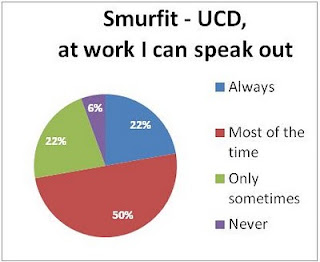
In fact, only about one in five dares to “always speak out.” That is about the same share of employees that feels “only sometimes” it is safe speak out. Nearly half of the employees speak out “only most of the time;” but then, large majorities are not known to say anything controversial.
Except for a slight suggestion that UCD respondents may be more afraid that others to speak out – or face greater sanctions (2% as against 5% say “Never”) these shares are remarkably stable. Both pie charts reflect the responses of MBA students at Anglophone programs. The first pie chart reflects the opinion in 2007 of mostly London Business School MBA alumni, where close to one third were American; while the second pie chart reflects opinions culled recently (2010) among 25 MBA students from Dublin, about two thirds of which were Irish, the rest were mostly other Europeans. Results for Brazilian FIA students (2008) as befits a more hierarchical society, showed a larger reticence to speak out but the sample of actual employees, not themselves bosses, was too small to compare with the other two samples

These shares are remarkably stable. Both pie charts reflect the responses of MBA students at Anglophone programs. The first pie chart reflects the opinion in 2007 of mostly London Business School MBA alumni, about one third of respondents were American; while the second pie chart reflects opinions culled recently (2010) among 25 Irish MBA students from Dublin. Results for Brazilian FIA students (2008) as befits a more hierarchical society, showed a larger reticence to speak out but the sample of actual employees, not themselves bosses, was too small to compare with the other two.
Why would so many be afraid to speak out?
Self preservation may have a lot to do with it. An in-depth study, also with close to 200 employees, (Detert and Edmondson, 2007) suggests that it is not speaking about problems that employees are most afraid of; problems are too objective to dismiss.
What employees withhold the most are suggestions for innovation. These carry a greater deal of uncertainty regarding the benefits to be accrued from speaking out; while they are certain to expose the employee who makes the suggestion. When in doubt, shutting up seems the safest route.
Detert and Edmonson suggest that the employees´ fears may be based only on no more than perceptions, or company myths, like stories of people disappearing sometime after making a suggestion.
Whether the myths are not more than myths, or not; a culture of fear helps only the surfacing of the bravest, not the brightest.
CEOs, when not bullies themselves, should do better by establishing a culture of glasnost rather than the gulag.
Reference.
James R. Detert, Amy C. Edmondson. Why Employees Are Afraid to Speak. Harvard Business Review. May 01, 2007. Prod. #: F0705B-PDF-ENG , pages 23-25.
Alfredo Behrens
The author is Professor of Leadership and Cross-Cultural Management at FIA, International MBA,
São Paulo, also the author of Culture and Management in the Americas, Stanford University Press, 2009; and of the manuscript “Shooting Heroes and Rewarding Cowards” to appear later in 2010. A presentation of the book can be seen at http://bit.ly/95aLM9
Contact: email me at ab*@*alfredobehrens.com after removing the *s.
An organizational culture with an innovation mindset should not muffle its collaborators. Yet too many employees are afraid to speak out.
In fact, only about one in five dares to “always speak out.” That is about the same share of employees that feels “only sometimes” it is safe speak out. Nearly half of the employees speak out “only most of the time;” but then, large majorities are not known to say anything controversial.
Except for a slight suggestion that UCD respondents may be more afraid that others to speak out – or face greater sanctions (2% as against 5% say “Never”) these shares are remarkably stable. Both pie charts reflect the responses of MBA students at Anglophone programs. The first pie chart reflects the opinion in 2007 of mostly London Business School MBA alumni, where close to one third were American; while the second pie chart reflects opinions culled recently (2010) among 25 MBA students from Dublin, about two thirds of which were Irish, the rest were mostly other Europeans. Results for Brazilian FIA students (2008) as befits a more hierarchical society, showed a larger reticence to speak out but the sample of actual employees, not themselves bosses, was too small to compare with the other two samples

These shares are remarkably stable. Both pie charts reflect the responses of MBA students at Anglophone programs. The first pie chart reflects the opinion in 2007 of mostly London Business School MBA alumni, about one third of respondents were American; while the second pie chart reflects opinions culled recently (2010) among 25 Irish MBA students from Dublin. Results for Brazilian FIA students (2008) as befits a more hierarchical society, showed a larger reticence to speak out but the sample of actual employees, not themselves bosses, was too small to compare with the other two.
Why would so many be afraid to speak out?
Self preservation may have a lot to do with it. An in-depth study, also with close to 200 employees, (Detert and Edmondson, 2007) suggests that it is not speaking about problems that employees are most afraid of; problems are too objective to dismiss.
What employees withhold the most are suggestions for innovation. These carry a greater deal of uncertainty regarding the benefits to be accrued from speaking out; while they are certain to expose the employee who makes the suggestion. When in doubt, shutting up seems the safest route.
Detert and Edmonson suggest that the employees´ fears may be based only on no more than perceptions, or company myths, like stories of people disappearing sometime after making a suggestion.
Whether the myths are not more than myths, or not; a culture of fear helps only the surfacing of the bravest, not the brightest.
CEOs, when not bullies themselves, should do better by establishing a culture of glasnost rather than the gulag.

Reference.
James R. Detert, Amy C. Edmondson. Why Employees Are Afraid to Speak. Harvard Business Review. May 01, 2007. Prod. #: F0705B-PDF-ENG , pages 23-25.
Alfredo Behrens
The author is Professor of Leadership and Cross-Cultural Management at FIA, International MBA,
São Paulo, also the author of Culture and Management in the Americas, Stanford University Press, 2009; and of the manuscript “Shooting Heroes and Rewarding Cowards” to appear later in 2010. A presentation of the book can be seen at http://bit.ly/95aLM9
Contact: email me at ab*@*alfredobehrens.com after removing the *s.
Wednesday, March 24, 2010
Como falar com seu CEO
Com frequência aprendemos a limitar a nossa conversa a um "elevator pitch" para dizer tudo o que é necessário sem ser inconveniente.
Reparem que nós viemos de uma cultura na qual "se mostrar" é censurável, por isso nao estamos preparados para aproveitar uma boa oportunidade para dar uma mensagem ao Chefe Supremo.
De forma que, tendo essa oportunidade para fazer uma boa impressão, o que fazer?
• Saiba de antemão como o seu trabalho e a sua meta encaixam na estratégia geral da organização. Se eles não encaixarem é melhor não falar para se dar o tempo de procurar outra organização
• Seja você mesmo(a). Não é fácil quando muito está em jogo, mas talvez seja preferivel parecer sem jeito, tímido/humilde do que fujão. Encare, desde que: o momento é de fato propício? Leia a situação, ser inconveniente será desabonador.
Abaixo tem um texto curto falando sobre estes assuntos. Vale a pena ler, embora devam ter presente que, vindo de Harvard, está orientado a americanos mais do que a brasileiros.
Abraços,
Alfredo
http://blogs.hbr.org/cs/2010/03/tips_for_making_small_talk_wit.html?cm_mmc=npv-_-DAILY_ALERT-_-AWEBER-_-DATE
_______________________
Alfredo Behrens
www.alfredobehrens.com
Reparem que nós viemos de uma cultura na qual "se mostrar" é censurável, por isso nao estamos preparados para aproveitar uma boa oportunidade para dar uma mensagem ao Chefe Supremo.
De forma que, tendo essa oportunidade para fazer uma boa impressão, o que fazer?
• Saiba de antemão como o seu trabalho e a sua meta encaixam na estratégia geral da organização. Se eles não encaixarem é melhor não falar para se dar o tempo de procurar outra organização
• Seja você mesmo(a). Não é fácil quando muito está em jogo, mas talvez seja preferivel parecer sem jeito, tímido/humilde do que fujão. Encare, desde que: o momento é de fato propício? Leia a situação, ser inconveniente será desabonador.
Abaixo tem um texto curto falando sobre estes assuntos. Vale a pena ler, embora devam ter presente que, vindo de Harvard, está orientado a americanos mais do que a brasileiros.
Abraços,
Alfredo
http://blogs.hbr.org/cs/2010/03/tips_for_making_small_talk_wit.html?cm_mmc=npv-_-DAILY_ALERT-_-AWEBER-_-DATE
_______________________
Alfredo Behrens
www.alfredobehrens.com
The day before the historic voting President Obama - fine example of a leader
Colleagues,
The American Health bill passed without a single Republican vote. The day before the historic voting President Obama harangued the Democrat caucus asking them for their vote in the House of Representatives.
The speech itself is a fine example of a leader showing the path and calling his followers to action.
The link below takes you to the speech´s high point and is fully worth five minutes of your time.
http://www.youtube.com/watch?v=YiYUVdwoHu4
Best regards,
Alfredo Behrens
Professor of Cross-Cultural Management
FIA, EMBA Internacional and IMBA
The American Health bill passed without a single Republican vote. The day before the historic voting President Obama harangued the Democrat caucus asking them for their vote in the House of Representatives.
The speech itself is a fine example of a leader showing the path and calling his followers to action.
The link below takes you to the speech´s high point and is fully worth five minutes of your time.
http://www.youtube.com/watch?v=YiYUVdwoHu4
Best regards,
Alfredo Behrens
Professor of Cross-Cultural Management
FIA, EMBA Internacional and IMBA
The relevance of the IT segment in India and the Syntel Case
Read in Portuguese
Comprising a population of 47 million people with access to the internet, 500 million mobile phones and an average urban per capita income of USD3000, India is one of the major markets for business involving technology. The country is a reference primarily in the Field of Information Technology.
This potential is furthered by the contribution posed by a favourable economic environment and the ample availability of qualified labour: there are 2 million graduates per annum in India, 500 thousand of who are engineers. Thus, there is a combination of resources (skilled people, support and investment), infrastructure (telecommunications, transport, power and financial structure) and a favourable environment (fiscal incentives, economic and political stability). So that one might grasp the standing of India´s services sector, this segment currently contributes with 55% of the nation´s GNP, wherein the leading fields are: telecommunications, banking and IT.
Since the 70´s, a remarkable evolution took place in the IT sector, special emphasis being accredited to the period between 1994-98, when training in IT picked up and knowledge in the field, widespread throughout India. New projects to qualify and promote ERP systems at enterprises were developed between 1999 and 2001. Currently, the country develops low cost, high scale, innovative and aligned technologies, which address businesses and corporate strategies. Future outcomes foresee full outsourcing and the creation of joint value between contractors and IT suppliers.
During the Executive MBA´s trip, we were granted the opportunity to meet and talk to Syntel executives. This IT company was founded in 1980 in India and currently counts on 12.500 employees, headquarters in Michigan, 10 centres in India and 3 in USA. Service lines include IT application and maintenance, corporate solutions and business operations.
During the company tour we were to verify great concern involving collaborator training whether in the form of in-house programs, training in partnership with customers or with large specialized companies. Special attention allocated to quality and customer satisfaction, likewise was evidenced, posing a case of an Indian technology company that not only competes for lower costs, but seeks to offer customized solutions that address all customer requirements. In this joint effort all stakeholder expectations are taken into account, process automation with views to increasing productivity and change process management resulting from the adoption of new technologies and systems.
This visit brings to light the IT sector´s potential, the importance of Indian companies to the segment and most of all, the sophistication of it´s management systems and customer relationships that go far beyond cost reductions!
Renata Giovinazzo Spers, Teacher and Assisting Coordenator of Projects at FIA – Profuturo and International MBA. Participated in January/2010 of study trips to India and South Africa by joining the International Executive MBA group. (renatag@fia.com.br)
Comprising a population of 47 million people with access to the internet, 500 million mobile phones and an average urban per capita income of USD3000, India is one of the major markets for business involving technology. The country is a reference primarily in the Field of Information Technology.
This potential is furthered by the contribution posed by a favourable economic environment and the ample availability of qualified labour: there are 2 million graduates per annum in India, 500 thousand of who are engineers. Thus, there is a combination of resources (skilled people, support and investment), infrastructure (telecommunications, transport, power and financial structure) and a favourable environment (fiscal incentives, economic and political stability). So that one might grasp the standing of India´s services sector, this segment currently contributes with 55% of the nation´s GNP, wherein the leading fields are: telecommunications, banking and IT.
Since the 70´s, a remarkable evolution took place in the IT sector, special emphasis being accredited to the period between 1994-98, when training in IT picked up and knowledge in the field, widespread throughout India. New projects to qualify and promote ERP systems at enterprises were developed between 1999 and 2001. Currently, the country develops low cost, high scale, innovative and aligned technologies, which address businesses and corporate strategies. Future outcomes foresee full outsourcing and the creation of joint value between contractors and IT suppliers.
During the Executive MBA´s trip, we were granted the opportunity to meet and talk to Syntel executives. This IT company was founded in 1980 in India and currently counts on 12.500 employees, headquarters in Michigan, 10 centres in India and 3 in USA. Service lines include IT application and maintenance, corporate solutions and business operations.
During the company tour we were to verify great concern involving collaborator training whether in the form of in-house programs, training in partnership with customers or with large specialized companies. Special attention allocated to quality and customer satisfaction, likewise was evidenced, posing a case of an Indian technology company that not only competes for lower costs, but seeks to offer customized solutions that address all customer requirements. In this joint effort all stakeholder expectations are taken into account, process automation with views to increasing productivity and change process management resulting from the adoption of new technologies and systems.
This visit brings to light the IT sector´s potential, the importance of Indian companies to the segment and most of all, the sophistication of it´s management systems and customer relationships that go far beyond cost reductions!
Renata Giovinazzo Spers, Teacher and Assisting Coordenator of Projects at FIA – Profuturo and International MBA. Participated in January/2010 of study trips to India and South Africa by joining the International Executive MBA group. (renatag@fia.com.br)
Wednesday, March 17, 2010
Brazilian School prepares MBAs for the world market
Read in Portuguese
Brazil has been competing successfully for the world market executive training.
The International MBA FIA will celebrate on March 17th the graduation of its 1st class with students from nine different countries.
They are young executives who have invested time and money to get training in business administration in Brazil. They have quit their jobs in the U.S., Europe and Latin America and chose coming to Brazil to obtain an internationally recognized MBA. In FIA, they have attended for a one year MBA, the only English spoken "full-time" MBA in Brazil.
Studying with Brazilian colleagues, whose most carried out the "part-time" version of the course in 20 months, international students took classes with Brazilians, Europeans and Americans professors, and absorbed much of the Brazilian culture of doing business.
With only 30 days after completing the course, more than 70% of the group is already being used in Brazil and abroad, and entrepreneurs have created their own businesses, generating employment in Brazil!
According to Professor James Wright, Coordinator of the International MBA FIA, "this course is a talent hotbed for Brazilian companies looking to expand its global presence. With an average of 6 years of professional experience, sense of entrepreneurship and a strong multicultural living, these young people are human capital of a first level for any company in the world." The teacher says that multinational companies have been faster to recognize this potential and hire the graduates of the first class. Internationalized Brazilian companies, as AmBev, Embraer, Gerdau, Votorantim, Unibanco, Itau, Camargo Correa, Odebrecht, Natura and others need to aggregate to their staff young people carrying exactly this profile, says Wright.
Brazil has been competing successfully for the world market executive training.
The International MBA FIA will celebrate on March 17th the graduation of its 1st class with students from nine different countries.
They are young executives who have invested time and money to get training in business administration in Brazil. They have quit their jobs in the U.S., Europe and Latin America and chose coming to Brazil to obtain an internationally recognized MBA. In FIA, they have attended for a one year MBA, the only English spoken "full-time" MBA in Brazil.
Studying with Brazilian colleagues, whose most carried out the "part-time" version of the course in 20 months, international students took classes with Brazilians, Europeans and Americans professors, and absorbed much of the Brazilian culture of doing business.
With only 30 days after completing the course, more than 70% of the group is already being used in Brazil and abroad, and entrepreneurs have created their own businesses, generating employment in Brazil!
According to Professor James Wright, Coordinator of the International MBA FIA, "this course is a talent hotbed for Brazilian companies looking to expand its global presence. With an average of 6 years of professional experience, sense of entrepreneurship and a strong multicultural living, these young people are human capital of a first level for any company in the world." The teacher says that multinational companies have been faster to recognize this potential and hire the graduates of the first class. Internationalized Brazilian companies, as AmBev, Embraer, Gerdau, Votorantim, Unibanco, Itau, Camargo Correa, Odebrecht, Natura and others need to aggregate to their staff young people carrying exactly this profile, says Wright.
Subscribe to:
Posts (Atom)