Friday, April 16, 2010

Internacionalização da Coteminas


Internacionalização da Coteminas
com Josué Gomes, Presidente da Coteminas


Esta palestra fará parte da visita da Vanderbilt University. O grupo de alunos do Executive MBA estão interessados em negócios globais e visitam a FIA em 05 de maio para aulas e esta palestra.

Em 05/05/2010 das 18h às 19h

Inscrições: http://palestrambavb.questionpro.com/

Tuesday, April 13, 2010

Global Mindset Inventory


Qual é seu grau de preparo para assumir responsabilidades internacionais?

Um diagnóstico para orientar os executivos e suas empresas no desenvolvimento das aptidões necessárias para atuação global.

Venha conhecer este instrumento aplicado em parceria com a Thunderbird Global School of Management que agora passa a incluir também o Brasil.

Inscrições: http://palestrambagmi2.questionpro.com/

Wednesday, March 31, 2010

The EMBA Vanderbilt group is coming to Brazil

Vanderbilt University is one of the most prestigious private Universities in the United States.

The EMBA group is coming to Brazil as part of their program studies for a lecture with the FIA International MBA on 5th May.

This group of students has a special interest in Global Business, the Brazilian business landscape and how both Brazilian and Multi-National companies operate in Brazil and Internationally. They are very experienced professionals with an average of 12 years business experience in diverse fields of industry and professions.

Friday, March 26, 2010

Férias à francesa em Lyon

Vinte séculos de história. Epicentro gastronômico mundial. Produtora de vinhos de renome internacional. Esses são apenas alguns motivos para conhecer a segunda maior cidade da França e seus arredores.

Consulte aqui o artigo da Revista Época Negócios indicado aos alunos que participarão da viagem técnica internacional do MBA Executivo Internacional, da FIA, pelo Prof. Alfredo Behrens,

When in doubt, shut up.

When in doubt, keep your mouth shut.

An organizational culture with an innovation mindset should not muffle its collaborators. Yet too many employees are afraid to speak out.
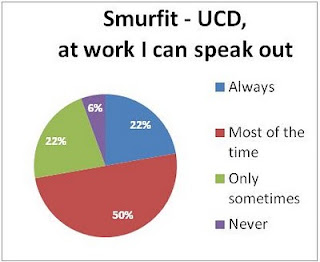
In fact, only about one in five dares to “always speak out.” That is about the same share of employees that feels “only sometimes” it is safe speak out. Nearly half of the employees speak out “only most of the time;” but then, large majorities are not known to say anything controversial.

Except for a slight suggestion that UCD respondents may be more afraid that others to speak out – or face greater sanctions (2% as against 5% say “Never”) these shares are remarkably stable. Both pie charts reflect the responses of MBA students at Anglophone programs. The first pie chart reflects the opinion in 2007 of mostly London Business School MBA alumni, where close to one third were American; while the second pie chart reflects opinions culled recently (2010) among 25 MBA students from Dublin, about two thirds of which were Irish, the rest were mostly other Europeans. Results for Brazilian FIA students (2008) as befits a more hierarchical society, showed a larger reticence to speak out but the sample of actual employees, not themselves bosses, was too small to compare with the other two samples


These shares are remarkably stable. Both pie charts reflect the responses of MBA students at Anglophone programs. The first pie chart reflects the opinion in 2007 of mostly London Business School MBA alumni, about one third of respondents were American; while the second pie chart reflects opinions culled recently (2010) among 25 Irish MBA students from Dublin. Results for Brazilian FIA students (2008) as befits a more hierarchical society, showed a larger reticence to speak out but the sample of actual employees, not themselves bosses, was too small to compare with the other two.


Why would so many be afraid to speak out?

Self preservation may have a lot to do with it. An in-depth study, also with close to 200 employees, (Detert and Edmondson, 2007) suggests that it is not speaking about problems that employees are most afraid of; problems are too objective to dismiss.
What employees withhold the most are suggestions for innovation. These carry a greater deal of uncertainty regarding the benefits to be accrued from speaking out; while they are certain to expose the employee who makes the suggestion. When in doubt, shutting up seems the safest route.
Detert and Edmonson suggest that the employees´ fears may be based only on no more than perceptions, or company myths, like stories of people disappearing sometime after making a suggestion.
Whether the myths are not more than myths, or not; a culture of fear helps only the surfacing of the bravest, not the brightest.
CEOs, when not bullies themselves, should do better by establishing a culture of glasnost rather than the gulag.


Reference.
James R. Detert, Amy C. Edmondson. Why Employees Are Afraid to Speak. Harvard Business Review. May 01, 2007. Prod. #: F0705B-PDF-ENG , pages 23-25.


Alfredo Behrens
The author is Professor of Leadership and Cross-Cultural Management at FIA, International MBA,
São Paulo, also the author of Culture and Management in the Americas, Stanford University Press, 2009; and of the manuscript “Shooting Heroes and Rewarding Cowards” to appear later in 2010. A presentation of the book can be seen at http://bit.ly/95aLM9
Contact: email me at ab*@*alfredobehrens.com after removing the *s.

Wednesday, March 24, 2010

Como falar com seu CEO

Com frequência aprendemos a limitar a nossa conversa a um "elevator pitch" para dizer tudo o que é necessário sem ser inconveniente.

Reparem que nós viemos de uma cultura na qual "se mostrar" é censurável, por isso nao estamos preparados para aproveitar uma boa oportunidade para dar uma mensagem ao Chefe Supremo.

De forma que, tendo essa oportunidade para fazer uma boa impressão, o que fazer?

• Saiba de antemão como o seu trabalho e a sua meta encaixam na estratégia geral da organização. Se eles não encaixarem é melhor não falar para se dar o tempo de procurar outra organização

• Seja você mesmo(a). Não é fácil quando muito está em jogo, mas talvez seja preferivel parecer sem jeito, tímido/humilde do que fujão. Encare, desde que: o momento é de fato propício? Leia a situação, ser inconveniente será desabonador.

Abaixo tem um texto curto falando sobre estes assuntos. Vale a pena ler, embora devam ter presente que, vindo de Harvard, está orientado a americanos mais do que a brasileiros.

Abraços,

Alfredo

http://blogs.hbr.org/cs/2010/03/tips_for_making_small_talk_wit.html?cm_mmc=npv-_-DAILY_ALERT-_-AWEBER-_-DATE
_______________________
Alfredo Behrens
www.alfredobehrens.com

The day before the historic voting President Obama - fine example of a leader

Colleagues,

The American Health bill passed without a single Republican vote. The day before the historic voting President Obama harangued the Democrat caucus asking them for their vote in the House of Representatives.

The speech itself is a fine example of a leader showing the path and calling his followers to action.

The link below takes you to the speech´s high point and is fully worth five minutes of your time.

http://www.youtube.com/watch?v=YiYUVdwoHu4

Best regards,

Alfredo Behrens
Professor of Cross-Cultural Management
FIA, EMBA Internacional and IMBA