Read in Portuguese
Comprising a population of 47 million people with access to the internet, 500 million mobile phones and an average urban per capita income of USD3000, India is one of the major markets for business involving technology. The country is a reference primarily in the Field of Information Technology.
This potential is furthered by the contribution posed by a favourable economic environment and the ample availability of qualified labour: there are 2 million graduates per annum in India, 500 thousand of who are engineers. Thus, there is a combination of resources (skilled people, support and investment), infrastructure (telecommunications, transport, power and financial structure) and a favourable environment (fiscal incentives, economic and political stability). So that one might grasp the standing of India´s services sector, this segment currently contributes with 55% of the nation´s GNP, wherein the leading fields are: telecommunications, banking and IT.
Since the 70´s, a remarkable evolution took place in the IT sector, special emphasis being accredited to the period between 1994-98, when training in IT picked up and knowledge in the field, widespread throughout India. New projects to qualify and promote ERP systems at enterprises were developed between 1999 and 2001. Currently, the country develops low cost, high scale, innovative and aligned technologies, which address businesses and corporate strategies. Future outcomes foresee full outsourcing and the creation of joint value between contractors and IT suppliers.
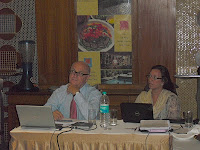
During the Executive MBA´s trip, we were granted the opportunity to meet and talk to Syntel executives. This IT company was founded in 1980 in India and currently counts on 12.500 employees, headquarters in Michigan, 10 centres in India and 3 in USA. Service lines include IT application and maintenance, corporate solutions and business operations.
During the company tour we were to verify great concern involving collaborator training whether in the form of in-house programs, training in partnership with customers or with large specialized companies. Special attention allocated to quality and customer satisfaction, likewise was evidenced, posing a case of an Indian technology company that not only competes for lower costs, but seeks to offer customized solutions that address all customer requirements. In this joint effort all stakeholder expectations are taken into account, process automation with views to increasing productivity and change process management resulting from the adoption of new technologies and systems.
This visit brings to light the IT sector´s potential, the importance of Indian companies to the segment and most of all, the sophistication of it´s management systems and customer relationships that go far beyond cost reductions!
Renata Giovinazzo Spers, Teacher and Assisting Coordenator of Projects at FIA – Profuturo and International MBA. Participated in January/2010 of study trips to India and South Africa by joining the International Executive MBA group. (renatag@fia.com.br)

Showing posts with label Renata Giovinazzo Spers. Show all posts
Showing posts with label Renata Giovinazzo Spers. Show all posts
Wednesday, March 24, 2010


Thursday, March 4, 2010
Prof. Dr. Renata Spers conducts research for post-doctorate at Vanderbilt University in Nashville, USA

The research deals with the identification of competitive advantages of communities in the Base of Pyramid and it is being developed jointly with Professor Edward Fischer, from the Center of Latin American Studies (CLAS), and Professor Bart Victor, from Owen Business School.
The teacher received a grant for research abroad from FAPESP - Fundação de Amparo a Pesquisa do Estado de Sao Paulo, as support for the research performance.
Read in Portuguese
Friday, February 12, 2010
Dabbawalas: Lições de Inovação e Gestão em Mumbai
Durante a viagem do grupo MBA Executivo à Índia, tivemos a oportunidade de aprender sobre interessantes casos de empresas inovadoras. Nas próximas semanas iremos compartilhar o que vimos, conhecemos e aprendemos durante a viagem, desde casos práticos, até discussões acadêmicas mais interessantes.
Um primeiro caso de sucesso que conhecemos é o dos “Dabbawala”.
O sistema dabbawala surgiu há mais de 100 anos, quando Mahadeo Havaji Bachche iniciou um sistema de entrega de refeições com aproximadamente 100 entregadores.
Atualmente 5000 dabawallas entregam por dia 200.000 marmitas em Mumbai, principalmente para executivos que trabalham em escritórios em áreas comerciais. “Dabbawala” em Marathi significa literalmente “entregador da caixa de almoço”. Marmitas são preparadas em casas e entregues aos clientes diariamente, entre 9h30 e 12h30. Os entregadores fazem a coleta, seleção e distribuição das marmitas para todos os clientes.
As entregas são feitas com bicicletas, carrinhos de mão e caixas de madeira, driblando o trânsito caótico de Mumbai e garantindo as entregas para almoço nos horários estipulados. Como grande parte dos 5000 entregadores são analfabetos, é utilizado um sistema de código particular de cores e letras. Cada marmita vem com o código desenhado na própria tampa, que pode ser entendido pelos funcionários. O turno de trabalho é dividido em grupos de 25 a 30 entregadores, conduzidos por um líder.
As marmitas passam por estações de trem para chegar até a área comercial, e são transportadas por bicicletas ou carrinhos até o destino final. Os índices de falha são praticamente zero - um erro a cada 16 milhões de entregas! Estes números já garantiram à empresa diversas certificações, dentre elas o Six Sigma Quality Certification. Os serviços prestados pelos dabbawalas são extremamente eficientes, garantindo a satisfação dos clientes.
Para este sucesso, disciplina de todos ao longo do processo é essencial. Usar um típico chapéu branco é obrigatório para os entregadores. Reportar-se sempre no horário e respeitar o cliente são valores fundamentais para os funcionários. Cooperação, coordenação, sinergia e estreita interação entre todos os membros é muito importante, pois para os dabbawala, “união é poder”!
A metodologia de trabalho, logística e valores dos dabbawala já são conhecidas em todo o mundo. Por causa da sua eficiência, o sistema tem sido explicado em palestras para empresas como Coca-Cola, Siemens, além de alunos de Harvard e Michigan.
Para saber mais, acesse o site www.mydabbawala.com
Renata Giovinazzo Spers, Professora e Coordenadora Ajunta de Projetos da FIA – Profuturo e International MBA. Participou em viagem de estudos para índia e África do Sul, com grupo do MBA Executivo Internacional, em janeiro/2010renatag@fia.com.br).

Um primeiro caso de sucesso que conhecemos é o dos “Dabbawala”.
O sistema dabbawala surgiu há mais de 100 anos, quando Mahadeo Havaji Bachche iniciou um sistema de entrega de refeições com aproximadamente 100 entregadores.
Atualmente 5000 dabawallas entregam por dia 200.000 marmitas em Mumbai, principalmente para executivos que trabalham em escritórios em áreas comerciais. “Dabbawala” em Marathi significa literalmente “entregador da caixa de almoço”. Marmitas são preparadas em casas e entregues aos clientes diariamente, entre 9h30 e 12h30. Os entregadores fazem a coleta, seleção e distribuição das marmitas para todos os clientes.
As entregas são feitas com bicicletas, carrinhos de mão e caixas de madeira, driblando o trânsito caótico de Mumbai e garantindo as entregas para almoço nos horários estipulados. Como grande parte dos 5000 entregadores são analfabetos, é utilizado um sistema de código particular de cores e letras. Cada marmita vem com o código desenhado na própria tampa, que pode ser entendido pelos funcionários. O turno de trabalho é dividido em grupos de 25 a 30 entregadores, conduzidos por um líder.
As marmitas passam por estações de trem para chegar até a área comercial, e são transportadas por bicicletas ou carrinhos até o destino final. Os índices de falha são praticamente zero - um erro a cada 16 milhões de entregas! Estes números já garantiram à empresa diversas certificações, dentre elas o Six Sigma Quality Certification. Os serviços prestados pelos dabbawalas são extremamente eficientes, garantindo a satisfação dos clientes.
Para este sucesso, disciplina de todos ao longo do processo é essencial. Usar um típico chapéu branco é obrigatório para os entregadores. Reportar-se sempre no horário e respeitar o cliente são valores fundamentais para os funcionários. Cooperação, coordenação, sinergia e estreita interação entre todos os membros é muito importante, pois para os dabbawala, “união é poder”!
A metodologia de trabalho, logística e valores dos dabbawala já são conhecidas em todo o mundo. Por causa da sua eficiência, o sistema tem sido explicado em palestras para empresas como Coca-Cola, Siemens, além de alunos de Harvard e Michigan.
Para saber mais, acesse o site www.mydabbawala.com
Renata Giovinazzo Spers, Professora e Coordenadora Ajunta de Projetos da FIA – Profuturo e International MBA. Participou em viagem de estudos para índia e África do Sul, com grupo do MBA Executivo Internacional, em janeiro/2010renatag@fia.com.br).
Subscribe to:
Comments (Atom)