Novos Mercados e Oportunidades
Carlos Mello e os convidados Pedro Amaral, headhunter, e o professor James Wright falam sobre os novos mercados e oportunidades para você aproveitar

Tuesday, June 2, 2009


Saturday, May 30, 2009
Nós, os sobreviventes
O que poderá mudar no perfil e no comportamento do consumidor brasileiro com a crise - e o que não vai mudar, apesar dela
NOVIDADE NO MERCADO? É COMIGO MESMO
A curiosidade própria do ser humano pode salvar muitas empresas em meio à instabilidade econômica. Especialistas ouvidos por AMANHÃ foram unânimes em afirmar que, com o cenário de crise, o consumidor reforçará a experiência com produtos novos. Ou seja, se você enxergar uma longa fila para comprar o aparelho celular mais recente, como aconteceu no lançamento do IPhone em junho de 2007, não se surpreenda. "O novo século entrega de bandeja para as empresas a oportunidade de poder fazer experiências coletivas com os consumidores. As pessoas estão sempre experimentando novidades, ainda mais em épocas de crise", teoriza Monica Gregori, diretora de negócios da Natura.
A opinião da executiva tem a chancela de analistas de consumo. É o caso do Programa de Estudos do Futuro (ProFuturo), ligado à faculdade de Administração da USP. "A inovação é um imperativo para a obtenção de vantagens competitivas sustentáveis, seja ela um mero detalhe no produto ou uma mudança radical em processos ou modelos de negócio", resume Antonio Thiago Benedette, pesquisador do ProFuturo. Não é à toa que esse comportamento do consumidor faz com que muitas companhias continuem investindo em inovação, mesmo diante do cenário adverso. No entanto, junto com a novidade há um grande desafio para os gestores de negócios: fazer com que o consumidor continue tendo interesse pelo produto ou serviço em oferta. "Conseguir passar o cliente para o estágio da lealdade e da retenção está ficando cada vez mais difícil, ainda mais em tempos em que a fidelidade não tem lá tanto valor para o consumidor", completa Benedette.
Outro perigo iminente para companhias inovadoras é a invasão de cópias de produtos que fizeram sucesso no mercado. Em função de avanços tecnológicos cada vez mais frequentes, em pouco tempo a concorrência consegue desenvolver um equipamento ou produto praticamente igual àquele que encantou os consumidores. E, como se não bastasse se preocupar em manter alta a curiosidade dos consumidores, os empresários ainda terão de suar para se livrar das cópias
NOVIDADE NO MERCADO? É COMIGO MESMO
A curiosidade própria do ser humano pode salvar muitas empresas em meio à instabilidade econômica. Especialistas ouvidos por AMANHÃ foram unânimes em afirmar que, com o cenário de crise, o consumidor reforçará a experiência com produtos novos. Ou seja, se você enxergar uma longa fila para comprar o aparelho celular mais recente, como aconteceu no lançamento do IPhone em junho de 2007, não se surpreenda. "O novo século entrega de bandeja para as empresas a oportunidade de poder fazer experiências coletivas com os consumidores. As pessoas estão sempre experimentando novidades, ainda mais em épocas de crise", teoriza Monica Gregori, diretora de negócios da Natura.
A opinião da executiva tem a chancela de analistas de consumo. É o caso do Programa de Estudos do Futuro (ProFuturo), ligado à faculdade de Administração da USP. "A inovação é um imperativo para a obtenção de vantagens competitivas sustentáveis, seja ela um mero detalhe no produto ou uma mudança radical em processos ou modelos de negócio", resume Antonio Thiago Benedette, pesquisador do ProFuturo. Não é à toa que esse comportamento do consumidor faz com que muitas companhias continuem investindo em inovação, mesmo diante do cenário adverso. No entanto, junto com a novidade há um grande desafio para os gestores de negócios: fazer com que o consumidor continue tendo interesse pelo produto ou serviço em oferta. "Conseguir passar o cliente para o estágio da lealdade e da retenção está ficando cada vez mais difícil, ainda mais em tempos em que a fidelidade não tem lá tanto valor para o consumidor", completa Benedette.
Outro perigo iminente para companhias inovadoras é a invasão de cópias de produtos que fizeram sucesso no mercado. Em função de avanços tecnológicos cada vez mais frequentes, em pouco tempo a concorrência consegue desenvolver um equipamento ou produto praticamente igual àquele que encantou os consumidores. E, como se não bastasse se preocupar em manter alta a curiosidade dos consumidores, os empresários ainda terão de suar para se livrar das cópias
Thursday, May 28, 2009
Leadership in Projects – The EMBRAER Experience
Leadership in Projects – The EMBRAER Experience
On May 22 nd, Luis Carlos Affonso , The Vice President for Executive Aviation of Embraer, made an impressive presentation on leading projects in Brazil’s most important high tech company. He has an outstanding record as chief engineer for the country’s first passenger jet, ERJ.147, and as program manager for its large 170/190 series airplanes, Embraer’s largest and most complex development project to date.
Now heading the new Executive Aviation Program, Luis Carlos has led this award winning program to a series of very successful initial product launches. A graduate of the 1996 FIA Executive MBA program, Luis Carlos Affonso was able to share with our participants his broad management experience and insights on leading large projects at Embraer, the third largest aircraft manufacturer in the world.
On May 22 nd, Luis Carlos Affonso , The Vice President for Executive Aviation of Embraer, made an impressive presentation on leading projects in Brazil’s most important high tech company. He has an outstanding record as chief engineer for the country’s first passenger jet, ERJ.147, and as program manager for its large 170/190 series airplanes, Embraer’s largest and most complex development project to date.
Now heading the new Executive Aviation Program, Luis Carlos has led this award winning program to a series of very successful initial product launches. A graduate of the 1996 FIA Executive MBA program, Luis Carlos Affonso was able to share with our participants his broad management experience and insights on leading large projects at Embraer, the third largest aircraft manufacturer in the world.
Wednesday, May 27, 2009
Primeiro case de um brasileiro publicado no LexisNexis
Primeiro case de um brasileiro publicado no LexisNexis
Artigo publicado por Mauricio Correa Camargo, aluno da turma 35 do MBA Executivo Internacional, no LexisNexis, sobre um case apresentado no Counsel to Counsel, Fórum sobre Gestão de Departamento Jurídico e Compliance, e promovido pelo Martindale-Hubbell, mais consultado e respeitado guia global de referência de advogados e escritórios do mundo jurídico.
Sua exposição foi relacionada ao alinhamento entre o departamento jurídico e o escritório externo, tendo como tema: "Using Outside Counsel Effectively to Achieve Company's Goals". Seu case foi escolhido como Best Practice pela organização do Fórum, que teve a participação de gestores dos departamento jurídico de empresas como: GE, 3M, Copersucar, Vale, Unilever, Nestlé, Sanofi-Aventis, Hewlett Packard, Siemens, International Paper, Tishman Speyer, Software AG, Foxconn, CIBA.
Leia mais:
http://c2c.martindale.com/nxtbooks/martindale/c2c_200905/#/8
http://c2c.martindale.com/nxtbooks/martindale/c2c_200905/#/2
Artigo publicado por Mauricio Correa Camargo, aluno da turma 35 do MBA Executivo Internacional, no LexisNexis, sobre um case apresentado no Counsel to Counsel, Fórum sobre Gestão de Departamento Jurídico e Compliance, e promovido pelo Martindale-Hubbell, mais consultado e respeitado guia global de referência de advogados e escritórios do mundo jurídico.
Sua exposição foi relacionada ao alinhamento entre o departamento jurídico e o escritório externo, tendo como tema: "Using Outside Counsel Effectively to Achieve Company's Goals". Seu case foi escolhido como Best Practice pela organização do Fórum, que teve a participação de gestores dos departamento jurídico de empresas como: GE, 3M, Copersucar, Vale, Unilever, Nestlé, Sanofi-Aventis, Hewlett Packard, Siemens, International Paper, Tishman Speyer, Software AG, Foxconn, CIBA.
Leia mais:
http://c2c.martindale.com/nxtbooks/martindale/c2c_200905/#/8
http://c2c.martindale.com/nxtbooks/martindale/c2c_200905/#/2
Monday, May 4, 2009
New FIA Executive MBA Video
You can now watch FIA's newest video, featuring the International Executive MBA course at our website.
Tuesday, April 14, 2009
So…how's Obama doing?
Jack and Suzy Welch recently graded Obama "on how he's doing on critical performance criteria as our country's CEO".
Vision and Team-Building
The Welches rightly argue that Obama has the vision “ ‘thing’ without which a person simply cannot lead.” Obama’s vision ranges from the Economy to the Environment passing through Social issues and Foreign Policy.
While an expression of Obama’s cogent vision on Foreign Policy is more recent, we know he has the “vision thing” because Obama is an excellent communicator, both in the technique and the approachability. Not only he has addressed domestic constituencies, he has also succeeded with foreign stakeholders. Quite something.
Next, the Welch’s turn to Obama’s competence in team-building. They give him credit for folding in an egotistic team with high potential for derailment.
The Welches are right. This initial team is a fractious one. Take Larry Summers, for instance. Because he is talented he has been in demanding positions. Yet, wherever he has been he has rubbed people the wrong way, from the World Bank to Harvard.
Perhaps a different question should be asked, are there not equally competent people with a higher team working proclivity that the ones that Obama has chosen? This is not an idle question because it is nurtured in the Obama-tension that surprises us.
It is to America’s credit, besides to Obama’s own, that he became President of the USA. But it still does not cease to surprise us a little. Perhaps it is too soon and it will go away. But perhaps Obama senses this and feels that he needed to put some easily recognizable faces in his team to make it more credible.
Surely Obama could have chosen a lower-key team. Why didn’t he? Because he does not believe they would be as competent, or because they would not be as credible? In which case, we would have to ask, who with does Obama want to communicate?
It could well be that by inviting the abrasive individuals in his administration Obama aimed at dispelling doubts among those who are concerned about his own weaknesses. Whatever the reason, individuals like Larry Summers and Hillary Clinton are a risk to the credibility of Obama’s message of hope bred in solidarity.
Speed and Authenticity
Next, the Welch’s turn to Obama’s “Speed” another fundamental ingredient to an effective CEO.
The challenges were many and the Welches believe that Obama may have initially moved on too many fronts, to the point of distracting attention on the “Big thing” which, no doubt, is the sad state of the economy.
Indeed, we saw some time spent on the ritual of signing-off a bill in support of equal pay for women. That may have been distracting, but it did not take long, and it was necessary. Had Obama not dedicated enough attention to issues like these he would have conveyed the impression that it was business as usual and we all know where that led us.
Authenticity is another issue altogether. There is a hint in the Welch’s analysis that Obama may not come across as authentic as is desirable for a leader, and that; fortunately, his wife makes up for that.
 It may well be that it is only a question of perception from the viewpoint of the Welch’s dinner party; but remember Obama’s choice of some abrasive individuals for his team? Negative perceptions add up, and erode a leader’s credibility. It could well be that Obama is not generally perceived as authentic enough and that it is too early to say so bluntly. But it may pile up and then be released on him with the force of an avalanche when he fails the first time, which he will.
The Welches do not mention the word charisma at all in the analysis of Obama as a leader. In a kind response to my comment Suzy Welch later clarified that “Obama's definitely charismatic” and suggested that this perception was implicit in their claim that Obama was a great communicator. Fair enough, but charisma is not the same as authenticity and this begs a different question: How inauthentic may an otherwise excellent communicator be before he is said to be lacking in charisma? I would say very little. If Obama were not perceived as authentic enough, he could hardly be seen as charismatic, despite his eloquence.
We know that charisma is a necessary quality for effectiveness in a leader because charisma awakens the level of affection among the followers which will lead them to forgive, even when the leader fails, as sometimes our Saints do; not because the Saints, or our leaders, are not on our side; but because the strength of the devilish creatures they must contend with may occasionally be just too much for them to succeed.
We do not cease to love our leader, nor our Saints, when they fail us; because we love them we forgive them. Take President Lula for instance. But will people cease to love Obama? No, it is unlikely that they will, because Obama, like Lula, are both Servant leaders. Their style of leadership is anchored in trust and in helping hands rather than in stark competitiveness. That style is unsettling to those in business circles and to them appears to be inauthentic, but it is not.
The Welches are generous with Obama and give him an A for leadership, though they may revise this if he fails to champion unpopular but necessary issues. Here is a comment on the four issues the Welches grade Obama on.
Vision and Team-Building
The Welches rightly argue that Obama has the vision “ ‘thing’ without which a person simply cannot lead.” Obama’s vision ranges from the Economy to the Environment passing through Social issues and Foreign Policy.
While an expression of Obama’s cogent vision on Foreign Policy is more recent, we know he has the “vision thing” because Obama is an excellent communicator, both in the technique and the approachability. Not only he has addressed domestic constituencies, he has also succeeded with foreign stakeholders. Quite something.
Next, the Welch’s turn to Obama’s competence in team-building. They give him credit for folding in an egotistic team with high potential for derailment.
The Welches are right. This initial team is a fractious one. Take Larry Summers, for instance. Because he is talented he has been in demanding positions. Yet, wherever he has been he has rubbed people the wrong way, from the World Bank to Harvard.
Perhaps a different question should be asked, are there not equally competent people with a higher team working proclivity that the ones that Obama has chosen? This is not an idle question because it is nurtured in the Obama-tension that surprises us.
It is to America’s credit, besides to Obama’s own, that he became President of the USA. But it still does not cease to surprise us a little. Perhaps it is too soon and it will go away. But perhaps Obama senses this and feels that he needed to put some easily recognizable faces in his team to make it more credible.
Surely Obama could have chosen a lower-key team. Why didn’t he? Because he does not believe they would be as competent, or because they would not be as credible? In which case, we would have to ask, who with does Obama want to communicate?
It could well be that by inviting the abrasive individuals in his administration Obama aimed at dispelling doubts among those who are concerned about his own weaknesses. Whatever the reason, individuals like Larry Summers and Hillary Clinton are a risk to the credibility of Obama’s message of hope bred in solidarity.
Speed and Authenticity
Next, the Welch’s turn to Obama’s “Speed” another fundamental ingredient to an effective CEO.
The challenges were many and the Welches believe that Obama may have initially moved on too many fronts, to the point of distracting attention on the “Big thing” which, no doubt, is the sad state of the economy.
Indeed, we saw some time spent on the ritual of signing-off a bill in support of equal pay for women. That may have been distracting, but it did not take long, and it was necessary. Had Obama not dedicated enough attention to issues like these he would have conveyed the impression that it was business as usual and we all know where that led us.
Authenticity is another issue altogether. There is a hint in the Welch’s analysis that Obama may not come across as authentic as is desirable for a leader, and that; fortunately, his wife makes up for that.
 It may well be that it is only a question of perception from the viewpoint of the Welch’s dinner party; but remember Obama’s choice of some abrasive individuals for his team? Negative perceptions add up, and erode a leader’s credibility. It could well be that Obama is not generally perceived as authentic enough and that it is too early to say so bluntly. But it may pile up and then be released on him with the force of an avalanche when he fails the first time, which he will.
The Welches do not mention the word charisma at all in the analysis of Obama as a leader. In a kind response to my comment Suzy Welch later clarified that “Obama's definitely charismatic” and suggested that this perception was implicit in their claim that Obama was a great communicator. Fair enough, but charisma is not the same as authenticity and this begs a different question: How inauthentic may an otherwise excellent communicator be before he is said to be lacking in charisma? I would say very little. If Obama were not perceived as authentic enough, he could hardly be seen as charismatic, despite his eloquence.
We know that charisma is a necessary quality for effectiveness in a leader because charisma awakens the level of affection among the followers which will lead them to forgive, even when the leader fails, as sometimes our Saints do; not because the Saints, or our leaders, are not on our side; but because the strength of the devilish creatures they must contend with may occasionally be just too much for them to succeed.
We do not cease to love our leader, nor our Saints, when they fail us; because we love them we forgive them. Take President Lula for instance. But will people cease to love Obama? No, it is unlikely that they will, because Obama, like Lula, are both Servant leaders. Their style of leadership is anchored in trust and in helping hands rather than in stark competitiveness. That style is unsettling to those in business circles and to them appears to be inauthentic, but it is not.
Thursday, March 19, 2009
To BRIC or not to BRIC? Is Brazil nurturing the leadership style it takes to innovate?
We have seen a lot on leadership and its impact on performance, but much less on leadership’s impact on innovation; however, the latter is crucial to business competitiveness. One would imagine that a leader cannot be truly effective if his organization’s innovation capabilities are inhibited because of the leader’s style. However, we know little on what leadership style would be most effective to promote innovation in business.
It may help to figure out what type of innovation we are talking about, because business innovation can be incremental or radical. The first improves on what already exists. The last creates something new. Most innovation is incremental. Radical innovations, like television or the sewing machine, are rarer. Still, however radical, an innovation is not such until business can deliver it, and that requires business can make a profit on it.
 Markides tells us in Fast Second that, for business to deliver an innovation, it takes transforming what may not be much more than a good idea into something that people will want to pay for at a price that business can make a profit on. This is why, Markides argues, that the company that takes a radical innovation to the market is seldom the one that developed the product in the first place. This happens because the company that developed the product frequently lacks the organizational skills that it takes to transform that product from the best possible into an affordable one and to market it and perhaps even support it after sales, Apple’s iPod and iPhone excepted.
That Apple’s leadership is exceptional, though perhaps not more than, say, Virgin’s Branson, suggests that, usually, firms that create radical innovations are led by people different from the ones that lead firms that produce incremental innovations. In the words of Stanford’s James March, a business that delivers incremental innovations chooses to exploits old certainties rather than explore new possibilities.
To explore new possibilities requires business to be comfortable with risk and ambiguities, it calls for an organizational culture that nurtures curiosity, which pays attention to needs and derives pleasure in satisfying wants. Oke et alli suggest that this type of leaders fits best the transformational type, which woo’s followers through charisma and by providing vision and generally making followers feel good about pursuing objectives, like radical innovation.
On the other hand, transactional leaders operate under the “carrot and stick” paradigm, which may seem dull but is operational in making modest things happen consistently, like delivering incremental innovation, which is most of what one appreciates on the shelves of department stores. Perhaps this is why, Markides contends, run of the mill corporations make so much fuss only to deliver marginally different goods.
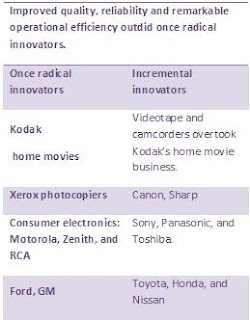
Yet that is not the whole story. Run of the mill corporations have the knack to transform prototypes into products, brand them and distribute them. Chicopee Mills, a unit of Johnson & Johnson developed the first disposable diaper, Chux, in 1932; but it was Procter&Gamble that spearheaded Pampers in the 1960s by making them cheap and practical enough for everyday use. P&G’s current leader, A.G. Lafley, is generally regarded as exceedingly effective in prodding his team to remain innovative, but it is innovation of the incremental type that P&G delivers.
What about businesses that deliver commodities, which is what most Brazilian big business delivers? There may still be innovation in the processes, though not in the product. Yet we know that the Brazilian leadership style is of the paternalistic kind, in my view, a substantial variation of transformational leadership. If the Brazilian leadership style were transformational we would have filled the basic leadership condition for nurturing innovation, which by and large, Brazilian corporations do not. Embraer is an exception, and it does not produce commodities.
Perhaps it is high time for large Brazilian corporations to enter into the market for products in order to train to focus on innovation. India’s Ratan Tata, with his low cost Nano automibile, has made a wake-up call; so has China’s Yang Yuanqing by turning IBM into Lenovo; and IBM is now bidding for Sun Microsystems. Should a Russian tycoon come up with an innovation Brazil would be left last among the BRICS.
Alfredo Behrens
FIA, International MBA
alfredob@fia.com.br
Read more
It may help to figure out what type of innovation we are talking about, because business innovation can be incremental or radical. The first improves on what already exists. The last creates something new. Most innovation is incremental. Radical innovations, like television or the sewing machine, are rarer. Still, however radical, an innovation is not such until business can deliver it, and that requires business can make a profit on it.
Markides tells us in Fast Second that, for business to deliver an innovation, it takes transforming what may not be much more than a good idea into something that people will want to pay for at a price that business can make a profit on. This is why, Markides argues, that the company that takes a radical innovation to the market is seldom the one that developed the product in the first place. This happens because the company that developed the product frequently lacks the organizational skills that it takes to transform that product from the best possible into an affordable one and to market it and perhaps even support it after sales, Apple’s iPod and iPhone excepted.That Apple’s leadership is exceptional, though perhaps not more than, say, Virgin’s Branson, suggests that, usually, firms that create radical innovations are led by people different from the ones that lead firms that produce incremental innovations. In the words of Stanford’s James March, a business that delivers incremental innovations chooses to exploits old certainties rather than explore new possibilities.
To explore new possibilities requires business to be comfortable with risk and ambiguities, it calls for an organizational culture that nurtures curiosity, which pays attention to needs and derives pleasure in satisfying wants. Oke et alli suggest that this type of leaders fits best the transformational type, which woo’s followers through charisma and by providing vision and generally making followers feel good about pursuing objectives, like radical innovation.
On the other hand, transactional leaders operate under the “carrot and stick” paradigm, which may seem dull but is operational in making modest things happen consistently, like delivering incremental innovation, which is most of what one appreciates on the shelves of department stores. Perhaps this is why, Markides contends, run of the mill corporations make so much fuss only to deliver marginally different goods.

Yet that is not the whole story. Run of the mill corporations have the knack to transform prototypes into products, brand them and distribute them. Chicopee Mills, a unit of Johnson & Johnson developed the first disposable diaper, Chux, in 1932; but it was Procter&Gamble that spearheaded Pampers in the 1960s by making them cheap and practical enough for everyday use. P&G’s current leader, A.G. Lafley, is generally regarded as exceedingly effective in prodding his team to remain innovative, but it is innovation of the incremental type that P&G delivers.
What about businesses that deliver commodities, which is what most Brazilian big business delivers? There may still be innovation in the processes, though not in the product. Yet we know that the Brazilian leadership style is of the paternalistic kind, in my view, a substantial variation of transformational leadership. If the Brazilian leadership style were transformational we would have filled the basic leadership condition for nurturing innovation, which by and large, Brazilian corporations do not. Embraer is an exception, and it does not produce commodities.
Perhaps it is high time for large Brazilian corporations to enter into the market for products in order to train to focus on innovation. India’s Ratan Tata, with his low cost Nano automibile, has made a wake-up call; so has China’s Yang Yuanqing by turning IBM into Lenovo; and IBM is now bidding for Sun Microsystems. Should a Russian tycoon come up with an innovation Brazil would be left last among the BRICS.
Alfredo Behrens
FIA, International MBA
alfredob@fia.com.br
Read more
- Constantinos Markides, Paul Geroski. Fast Second: How Smart Companies Bypass Radical Innovation to Enter and Dominate New Markets. John Wiley and Sons, 2004.
- Adegoke Oke, Natasha Munshi and Fred O. Walumba. The Influence of Leadership on Innovation Processes and Activities. Organizational Dynamics. Volume 38, Issue 1, January-March 2009, Pages 64-72.
Subscribe to:
Posts (Atom)